
Tyre Hill House is a specialist residential family centre in Worcestershire providing multidisciplinary parenting assessment and support for parents and children.
We undertake residential family assessments commissioned by local authorities, working with social workers, commissioning and placement teams, children’s guardians, solicitors and the wider professional network.
Our assessments consider parenting capacity, capacity to change and whether a child’s needs can be met safely and sustainably within their family.
Information for professionals
Assessments are individually planned around the child, family and commissioning or court brief. A residential assessment will typically last between 12 and 16 weeks, depending on the needs and complexity of the family and the questions the assessment is required to answer.
Our approach combines ParentAssess, skilled residential observation, trauma-informed assessment, psychological formulation and specialist multidisciplinary expertise.
Our experienced assessing social workers are accustomed to working within complex child protection and public law proceedings, producing analytical reports for local authorities and the court and, where required, giving evidence in court and being professionally accountable for their analysis and conclusions.
We welcome early conversations about individual families, including where professionals are uncertain whether Tyre Hill House is the right setting.
Information for parents
Availability and referral enquiries
We do not publish live availability because capacity, suitability and matching need to be considered together.
Contact our team to discuss:
Current or upcoming availability
Suitability and matching
Assessment questions and timescales
Specialist or accessibility needs
The information required to progress a referral.
You do not need to have completed a formal referral before speaking to us.


Who we work with
We work with families where there are questions about parenting capacity, capacity to change and a child’s safety, wellbeing or development.
This can include families where parenting concerns sit alongside learning disability or cognitive needs, neurodivergence, previous domestic abuse, a history of substance misuse, trauma, mental health difficulties, care experience, previous proceedings or limited support networks.
Complexity in itself does not determine suitability. We consider how different needs and risks interact, what they mean for parenting and whether they can be safely and appropriately assessed within a residential setting.
There are some circumstances where Tyre Hill House will not be an appropriate placement. These include:
Parents under the age of 18
Current active substance misuse
Current domestic abuse within the relationship of parents seeking placement together
Current self-harming behaviour.
Suitability is considered individually. We consider the referral questions, identified risks, the needs of the child and parent, specialist input and reasonable adjustments required, and compatibility with families already living at Tyre Hill House.
Where there is uncertainty, we encourage an initial conversation rather than assuming a family is unsuitable.
Full admission and exclusion criteria are set out in our Statement of Purpose.
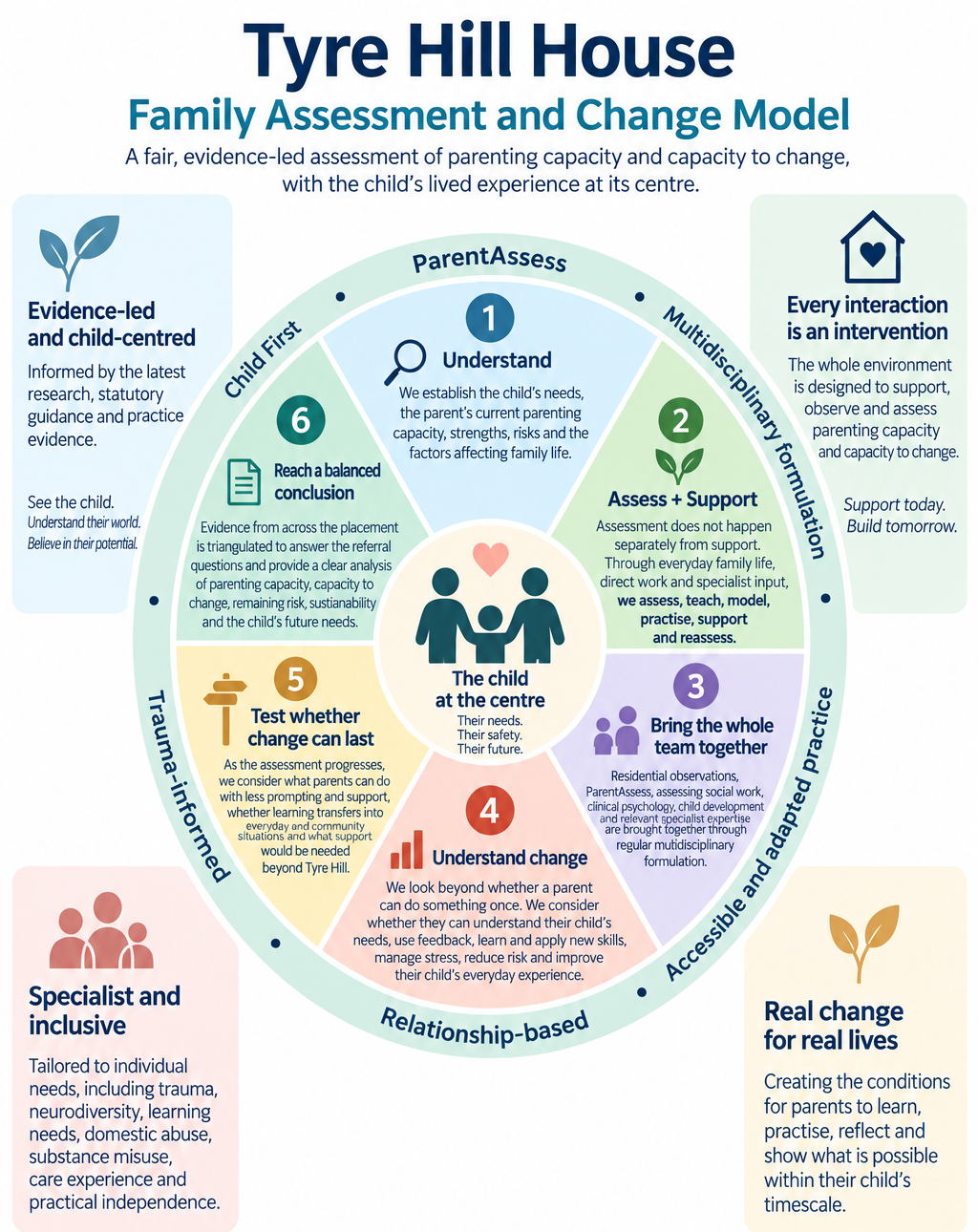
Our Family Assessment and Change Model
Our Family Assessment and Change Model provides a coherent framework for understanding parenting capacity, capacity to change and what any change means for the child.
Every assessment is individualised around the child and family and the questions set by the court, local authority or commissioning brief.
The model reflects an important principle in our approach: assessment should do more than describe what a parent is doing. It should help us understand why, what happens when appropriate support is provided, whether meaningful change occurs and whether that change can be sustained within the child’s timescale.

ParentAssess: one approach across the whole service
ParentAssess is the overarching assessment model at Tyre Hill House.
All staff are trained in ParentAssess, skilled observation and trauma-informed assessment, creating a consistent approach across the residential environment rather than assessment sitting solely with the assessing social worker.
We consider how each parent understands, communicates, processes, retains and applies information. Where needed, assessment and support are adapted through visual information, modelling, repetition, practical demonstration, manageable steps, additional processing time and checking understanding.
Our approach is to assess, teach, model, practise, support and reassess.
This gives parents the best possible opportunity to understand, participate, develop and demonstrate their parenting capacity. It also strengthens the assessment evidence by helping us distinguish between difficulties arising from the way information or support has been provided and difficulties learning, applying or sustaining parenting skills despite appropriate adaptation and support.
Evidence-led and child-centred
The child’s lived experience is the central reference point throughout the assessment.
We consider parenting within the context of the individual child: their age and development, safety, health, emotional needs, relationships, cues and responses, and what everyday family life feels like for them.
No single incident, observation, assessment tool or professional determines the outcome.
Evidence is gathered and triangulated over time from everyday residential observation, direct work, parent-child interaction, specialist assessment and intervention, child development, the parent’s perspective, information from the professional network and multidisciplinary formulation.
This creates a clear line of sight from the original referral questions through assessment and intervention to the evidence underpinning the final analysis.
The team
Every interaction is an intervention
Residential assessment enables us to understand parenting within the reality of everyday family life.
Our staff see the ordinary moments: feeding, play, comfort, routines, appointments, frustration, tiredness, competing demands, moments of connection and times when things become difficult.
Staff do more than observe. They support, model, coach, challenge, practise, reflect and give feedback.
Everyday interactions can therefore provide both an opportunity for change and evidence about capacity to change.
We are interested not only in what happened, but in how the parent responded to support, what they understood, what they did differently afterwards and whether that made a difference to their child.
Specialist and inclusive
Our multidisciplinary team brings together experienced assessing social workers, clinical psychology, early years and child development expertise, domestic abuse and substance misuse specialists, care-experience expertise and family support workers providing 24-hour observation and support.
Specialist expertise is integrated into the assessment rather than operating as a series of disconnected assessments.
Psychological formulation helps the team develop a shared understanding of the family’s history, experiences, relationships, strengths, vulnerabilities, risks and patterns of behaviour, and how these may be affecting parenting.
Regular multidisciplinary formulation brings that understanding together with residential evidence, ParentAssess, direct work, specialist expertise, the parent’s perspective and the child’s lived experience.
The result is one family, one shared formulation and one coherent assessment plan.
It also enables us to remain professionally curious: testing different explanations against the evidence rather than allowing an early hypothesis, diagnosis or individual professional perspective to become the conclusion.
Real change for real lives
We assess capacity to change, not simply whether improvement can be demonstrated within the highly supported environment of a residential family centre.
We consider whether parents can understand their child’s needs and professional concerns, reflect on their parenting, use feedback and support, learn and apply new skills, recognise and manage risk and remain child-focused when under pressure.
As the assessment progresses, we consider whether learning can be generalised into different situations and what parents can do with less prompting, structure and support.
Our final analysis distinguishes between progress that remains dependent upon high levels of external support and change that is understood, applied, generalised and capable of being sustained beyond Tyre Hill House.
Information for professionals
From evidence to professional analysis
The purpose of gathering evidence is not simply to produce a chronology of what happened during the placement.
Our assessing social workers bring the evidence together into a clear, balanced and impartial assessment addressing the questions within the agreed remit.
Residential evidence is considered alongside specialist contributions, psychological formulation, the parent’s perspective, information from the wider professional network and evidence about the child’s experience.
Where assessments form part of public law proceedings, reports are prepared with an understanding of the requirements of the court and the need for conclusions to be clear, evidence-based and capable of professional scrutiny.
Our assessing social workers have experience of preparing reports for court, working alongside legal and children’s social care professionals and giving oral evidence where required.
Management oversight and multidisciplinary review provide additional challenge and quality assurance while preserving the professional accountability of the assessing social worker for the final assessment.
Our pre-birth pathway
Tyre Hill House can provide a planned pre-birth and post-birth assessment pathway where concerns about parenting capacity are identified during pregnancy.
Beginning work before the baby is born provides valuable time to understand the parent, their history, strengths, vulnerabilities, learning and communication needs and support network before the additional demands of caring for a newborn.
It also enables us to begin ParentAssess work, multidisciplinary and psychological formulation, parenting preparation and relevant specialist intervention before birth.
Following the baby’s birth, the pathway can move into direct observation and support of parenting, including the developing parent-infant relationship, sensitivity to the baby’s cues, practical care and the parent’s ability to use and apply support.
This can be particularly valuable where proceedings are anticipated around the time of birth. Planning the residential pathway in advance provides greater continuity of assessment and support during the important period before, during and immediately following birth, rather than assessment beginning only once proceedings are underway.
The precise pathway and timing are agreed individually with the local authority and, where relevant, within the court process.
Supporting care-experienced parents
We have particular expertise in supporting parents who have themselves experienced care.
Care experience is considered within the formulation rather than simply recorded as part of the parent’s history.
We consider its potential impact on relationships, trust, identity, experiences of professional authority, practical independence and the support networks available to the parent.
Through our relationship with the Rees Foundation, care-experienced parents can also access enhanced practical, relational and transition support, with connections established during the placement wherever possible.
This is particularly important where a parent may be expected to demonstrate sustainable parenting without the family and practical support networks that others may take for granted.
Preparation begins before the family arrives.
We work with the placing authority to clarify the assessment brief, relevant court directions where applicable, risks, professional expectations, family needs and any adjustments required. Families receive accessible information about Tyre Hill House and what to expect.
Following admission, we establish the family’s starting point and develop an individualised assessment and support plan.
A residential assessment will usually take 12–16 weeks, although the precise timescale will depend upon the family’s needs and complexity, the child’s timescale and the questions the assessment needs to answer.
Progress is reviewed throughout the placement through multidisciplinary formulation and professional review. Emerging evidence is used to refine the assessment and support plan so that work remains purposeful and connected to the agreed assessment questions.
Sub heading
Admission, assessment and transition
As parents make positive progress, and where it is safe and agreed to do so, the assessment can increasingly test parenting with greater independence and reduced levels of support and observation.
Transition is planned rather than treated as a single point at the end of the assessment. We consider what has changed, whether that change can transfer beyond Tyre Hill House and what relationships, services, safeguards and practical support will be required for progress to continue.
For some families whose assessment supports parenting continuing in the community, Tyre Hill House can provide a planned period of continued support following the residential placement.
This enables familiar practitioners to work alongside the family as learning is transferred into their own home and community, helping to bridge the transition from a highly supported residential environment into everyday family life.
The nature and duration of any continued support are individually agreed with the placing authority as part of the transition plan.
Information for professionals
Assessment
The child’s safety, wellbeing and lived experience remain central throughout the placement.
Tyre Hill House operates 24-hour CCTV throughout the house and family apartments, monitored at all times. This level of observation is the starting point for all families and forms an important part of our safeguarding and assessment framework.
Observation is not necessarily static throughout the placement.
As a family makes positive progress through the assessment, the level and nature of observation can be reviewed and, where appropriate, varied in consultation and agreement with the placing local authority and, where relevant, the court.
This enables reduced observation and greater independence to become a purposeful part of the assessment itself. It allows us to understand what parents can manage as immediate oversight and support reduce, while ensuring that any change is planned and consistent with the child’s safety and the agreed assessment framework.
CCTV evidence sits alongside skilled residential observation, ParentAssess, direct work and multidisciplinary analysis. It does not replace professional observation or relational practice.
Families receive 24-hour support from staff trained in ParentAssess, skilled observation and trauma-informed assessment, alongside relevant specialist input.
Risk is assessed and reviewed throughout the placement through everyday practice, management oversight and multidisciplinary formulation. We maintain communication with the placing authority and communicate significant safeguarding concerns or changes in risk appropriately.
Parents receive regular and honest feedback so they understand what is going well, where concerns remain and what they are being asked to demonstrate.
Making a referral
We aim to make the referral process straightforward.
-
Contact us to discuss the family, assessment required, proposed timescale and current or upcoming availability.
-
We will ask for relevant information about the child and parents, professional involvement, identified risks, previous assessments and the questions the assessment needs to address.
-
We consider the assessment brief, risks, specialist and accessibility needs, matching and whether Tyre Hill House can safely and appropriately undertake the assessment.
-
Where required, we speak with the referring social worker and other relevant professionals to clarify the assessment requirements, risks and proposed approach.
-
Where the referral is accepted, we agree the proposed assessment, anticipated timescale and arrangements for admission.
-
We work with the placing authority and family to prepare for arrival, including placement planning, risk management and any adjustments required from the outset.
Professional information and downloads
Statement of Purpose
Full information about the service, admission and exclusion criteria and operating arrangements.
Referral Form
The information required for us to consider a proposed placement.
Discuss a referral
If you are considering a residential family assessment, contact Tyre Hill House to discuss the family, assessment requirements, suitability, timescales and current or upcoming availability.